
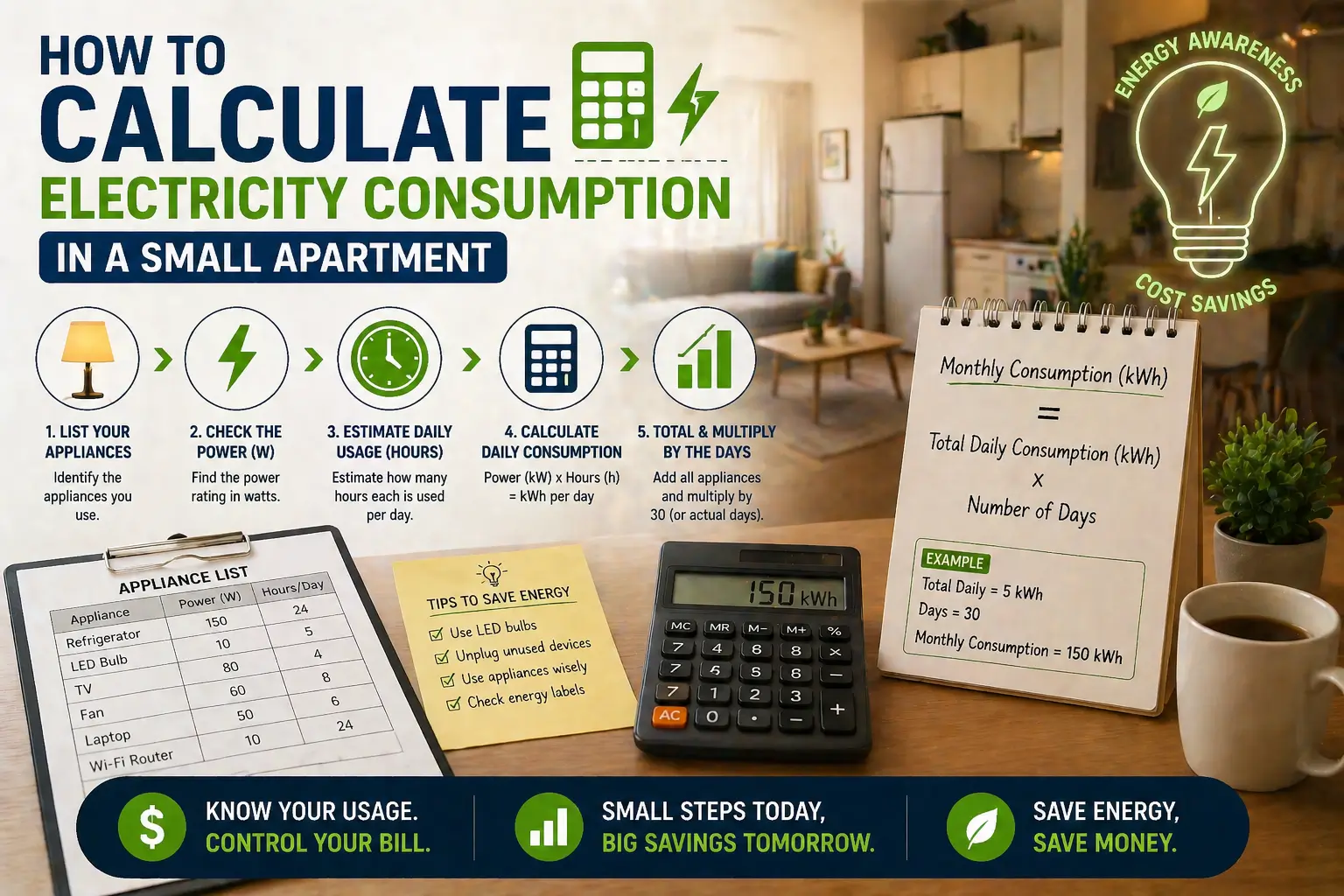
You look at your electricity bill and see a number—but it doesn’t really explain much. Why is it that high? Which appliance is responsible? And more importantly, what can you actually do about it?
This is a common situation in small apartments. People try to save energy, but without understanding how consumption is calculated, it’s hard to know what’s working.
The good news is that you don’t need to be an expert to figure it out. Once you understand the basics, you can estimate your usage and make better decisions.
What “Electricity Consumption” Actually Means
Electricity consumption is measured in kilowatt-hours (kWh). This unit represents how much energy an appliance uses over time.
Instead of thinking about power alone (watts), you need to consider:
- How powerful the appliance is
- How long it runs
That combination is what determines your total consumption.
For example, a powerful device used briefly might consume less than a weaker one used all day.
The Basic Formula (Simple and Practical)
Here’s the key formula used to calculate electricity consumption:
\text{kWh} = \frac{\text{Watts} \times \text{Hours of Use}}{1000}
This means:
- Multiply the appliance’s wattage by the number of hours used
- Divide by 1000 to convert to kWh
That’s exactly what your electricity bill is based on.
Step-by-Step: Calculating a Single Appliance
Let’s say you want to calculate your refrigerator usage.
Example:
- Power: 150 watts
- Usage: 24 hours per day
Step-by-step:
- 150 × 24 = 3600 watt-hours
- 3600 ÷ 1000 = 3.6 kWh per day
Over a month:
- 3.6 × 30 = 108 kWh
This shows how one appliance can represent a large portion of your total consumption.
Real-Life Example: Comparing Two Habits
Now let’s compare two scenarios using the same appliance.
Scenario A:
- Air conditioner used 3 hours per day
Scenario B:
- Air conditioner used 8 hours per day
Even with the same device, Scenario B will consume significantly more electricity.
This happens because time of use has a direct impact on consumption—not just the appliance itself.
Why This Calculation Helps in Real Life
Understanding this formula gives you control.
Instead of guessing, you can:
- Identify which appliances consume the most
- Adjust usage time
- Estimate savings before making changes
For example, if you reduce usage from 6 hours to 4 hours per day, you can quickly estimate how much energy you’ll save.
Estimating Total Apartment Consumption
You don’t need to calculate everything perfectly. A rough estimate is already useful.
Start by listing your main appliances:
- Refrigerator
- Air conditioner or fan
- Lighting
- TV and electronics
Then estimate:
- Power (watts)
- Daily usage (hours)
Add everything together to get a general idea of your monthly consumption.
This is often enough to identify where most energy is going.
Practical Checklist to Start Today
If you want to apply this in a simple way:
- Choose 3–5 main appliances
- Check their wattage (label or manual)
- Estimate daily usage time
- Calculate kWh using the formula
- Compare which ones consume the most
You don’t need perfect accuracy. Even rough numbers reveal useful patterns.
Common Mistakes That Increase Electricity Bills
Many people miscalculate or misunderstand their consumption due to small mistakes:
- Ignoring usage time
- Focusing only on appliance size
- Forgetting devices that run all day (like refrigerators)
- Not considering standby power
For example, a device with low wattage can still consume a lot if it runs continuously.
Signs You Are Wasting Electricity Without Noticing
Once you understand consumption, certain patterns become obvious:
- Your bill is higher than expected based on usage
- Some appliances run longer than necessary
- You don’t know how much each device consumes
- You rely on guesswork instead of estimates
These signs usually mean there’s room for improvement.
Before vs After: Understanding Your Consumption
Before:
- No idea where energy is going
- Decisions based on guesswork
- No clear way to reduce costs
After:
- Clear understanding of usage
- Ability to estimate consumption
- More control over energy decisions
The difference is not just knowledge—it’s control.
FAQ
Do I need exact numbers to calculate consumption?
No. Estimates are enough to understand patterns and make improvements.
Where can I find appliance wattage?
Usually on a label, manual, or manufacturer’s website.
Is calculating consumption complicated?
Not really. Once you understand the formula, it becomes straightforward.
Does reducing usage time really help?
Yes. Since time directly affects consumption, even small reductions can lower your bill.
Final Thoughts
Calculating electricity consumption might seem technical at first, but it quickly becomes practical once you understand the basics.
In a small apartment, where energy use is easier to track, this knowledge becomes even more valuable.
You don’t need to measure everything perfectly. Just understanding which appliances consume more—and why—already puts you ahead.
From there, every small adjustment becomes more intentional. And over time, that’s what leads to real savings.