
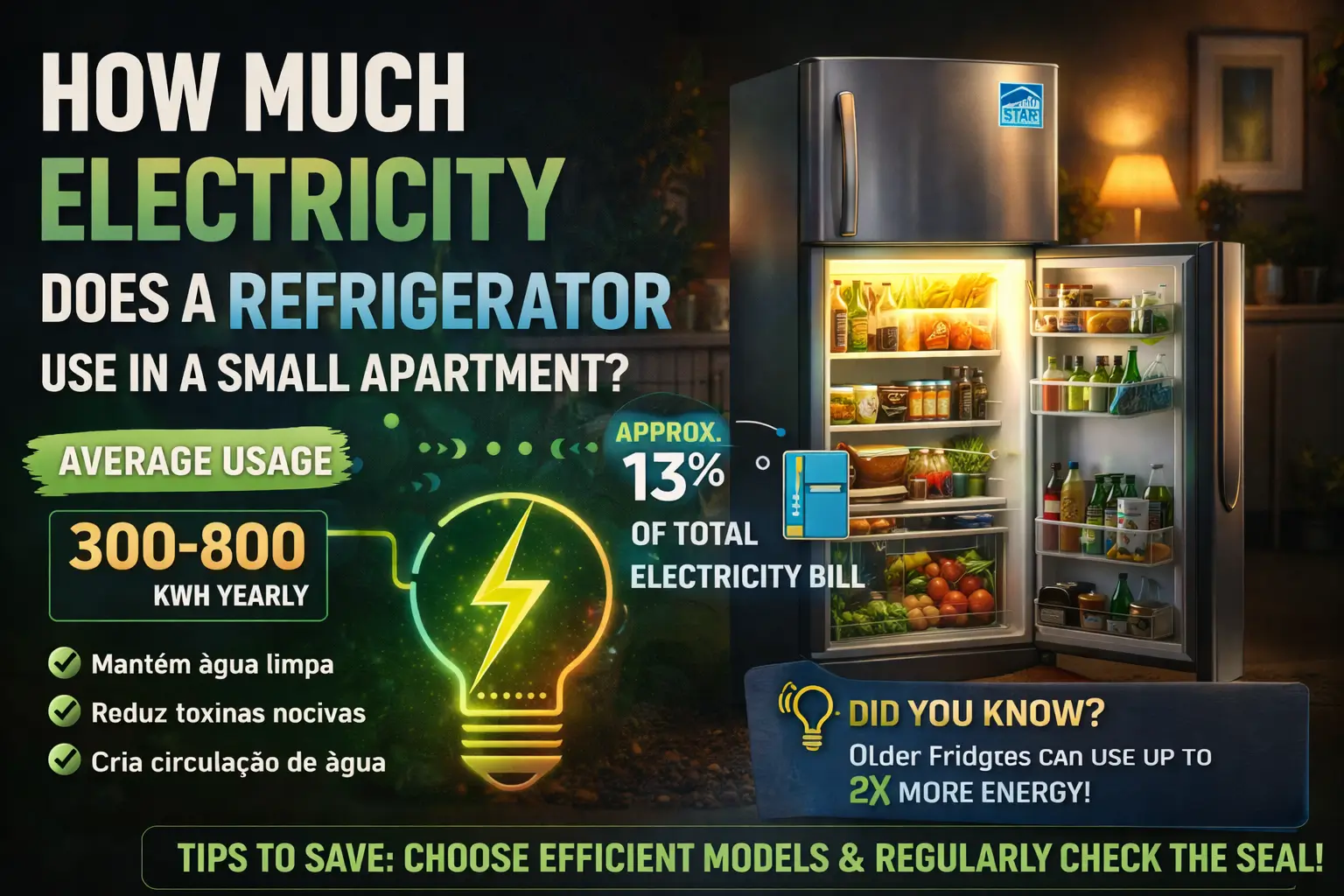
You might not think much about your refrigerator when trying to reduce your electricity bill. It just sits there, quietly doing its job. But when your monthly bill arrives higher than expected, the fridge is often part of the reason.
In a small apartment, where there are fewer appliances overall, the refrigerator becomes one of the main sources of energy consumption simply because it never stops running.
Understanding how much electricity it actually uses—and why—can help you make smarter decisions and avoid unnecessary costs.
How Much Electricity Does a Refrigerator Typically Use?
The exact consumption depends on the size, model, and efficiency of the appliance. But in general, a standard refrigerator in a small apartment uses between 30 and 60 kWh per month.
That might not sound like much at first. But because it runs 24 hours a day, every day, it becomes a consistent part of your electricity bill.
For example, if your total monthly consumption is around 150 kWh, your refrigerator alone could represent up to one-third of that.
This is why even small inefficiencies can have a noticeable impact over time.
Why Refrigerators Consume Energy Continuously
Unlike other appliances, a refrigerator doesn’t turn off completely. It cycles on and off throughout the day to maintain a stable internal temperature.
This happens because:
- Warm air enters every time the door is opened
- The compressor needs to work harder in hot environments
- Poor insulation causes cold air to escape
In practice, the fridge is always “working in the background,” even when you’re not thinking about it.
For instance, opening the fridge multiple times while cooking may seem harmless, but it forces the system to restart its cooling cycle repeatedly.
Factors That Increase Refrigerator Energy Consumption
Not all refrigerators consume energy in the same way. Several factors can increase usage:
- Age of the appliance (older models are less efficient)
- Door seal condition
- Room temperature
- Internal organization
- Frequency of use
A simple example: placing a refrigerator next to a stove or in direct sunlight can increase its workload. The higher the external temperature, the harder it has to work to stay cold.
Another common situation is overcrowding. When airflow inside the fridge is blocked, cooling becomes less efficient.
Real-Life Example: Small Habit, Real Cost
Imagine two people living in similar apartments with identical refrigerators.
- Person A opens the fridge only when necessary and keeps it well organized
- Person B opens it frequently and leaves it open while deciding what to eat
Over a month, Person B’s refrigerator will use more energy—not because the appliance is different, but because the usage pattern is.
This is one of those cases where behavior directly affects consumption.
Practical Checklist to Reduce Refrigerator Energy Use
If you want to keep your fridge efficient, start with these simple steps:
- Check if the door seals tightly
- Avoid placing hot food directly inside
- Keep the fridge away from heat sources
- Organize items to reduce door-open time
- Do not overload or block air circulation
- Adjust temperature settings to a moderate level
These are small adjustments, but together they reduce how often the compressor needs to work.
Common Mistakes That Increase Electricity Bills
Some habits make refrigerators consume more energy without people realizing it:
- Leaving the door open too long
- Setting the temperature lower than necessary
- Ignoring worn-out seals
- Placing the fridge in a hot location
For example, setting the temperature too low doesn’t preserve food better—it just increases energy use.
In many cases, people assume colder is always better, but that’s not how refrigerators are designed to work efficiently.
Signs You Are Wasting Electricity Without Noticing
Your refrigerator may be using more energy than necessary if you notice:
- It runs almost constantly without stopping
- The exterior feels unusually warm
- Your electricity bill increases without other changes
- Food freezes in areas where it shouldn’t
These signs suggest the appliance is working harder than it should.
Sometimes the issue is simple, like a worn seal or poor positioning in the kitchen.
Comparing Efficient vs Inefficient Use
Let’s look at a simple comparison:
- Efficient use → moderate temperature, organized interior, minimal door opening
- Inefficient use → very low temperature, frequent opening, poor sealing
Over time, the inefficient setup can lead to noticeably higher electricity consumption.
Even a small difference—like a few extra kWh per month—adds up over a year.
FAQ
Does a bigger refrigerator always use more electricity?
Not necessarily. Efficiency depends more on the model and technology than just size.
Is it better to keep the fridge very full or nearly empty?
A moderately filled fridge works best. Too empty or too full can reduce efficiency.
How often should I check the door seal?
At least every few months. A simple test is to close the door on a piece of paper—if it slides out easily, the seal may be worn.
Can unplugging the fridge save energy?
No. Since it stores food, it needs to run continuously. The focus should be on using it efficiently.
Final Thoughts
In a small apartment, your refrigerator is one of the few appliances that never takes a break. That’s why its impact on your electricity bill is bigger than most people expect.
The good news is that you don’t need to replace it to see improvements. Small changes in how you use and maintain your fridge can reduce energy consumption over time.
Pay attention to daily habits, keep the appliance in good condition, and avoid common mistakes. These simple actions can make your refrigerator more efficient—and your electricity bill more manageable.